
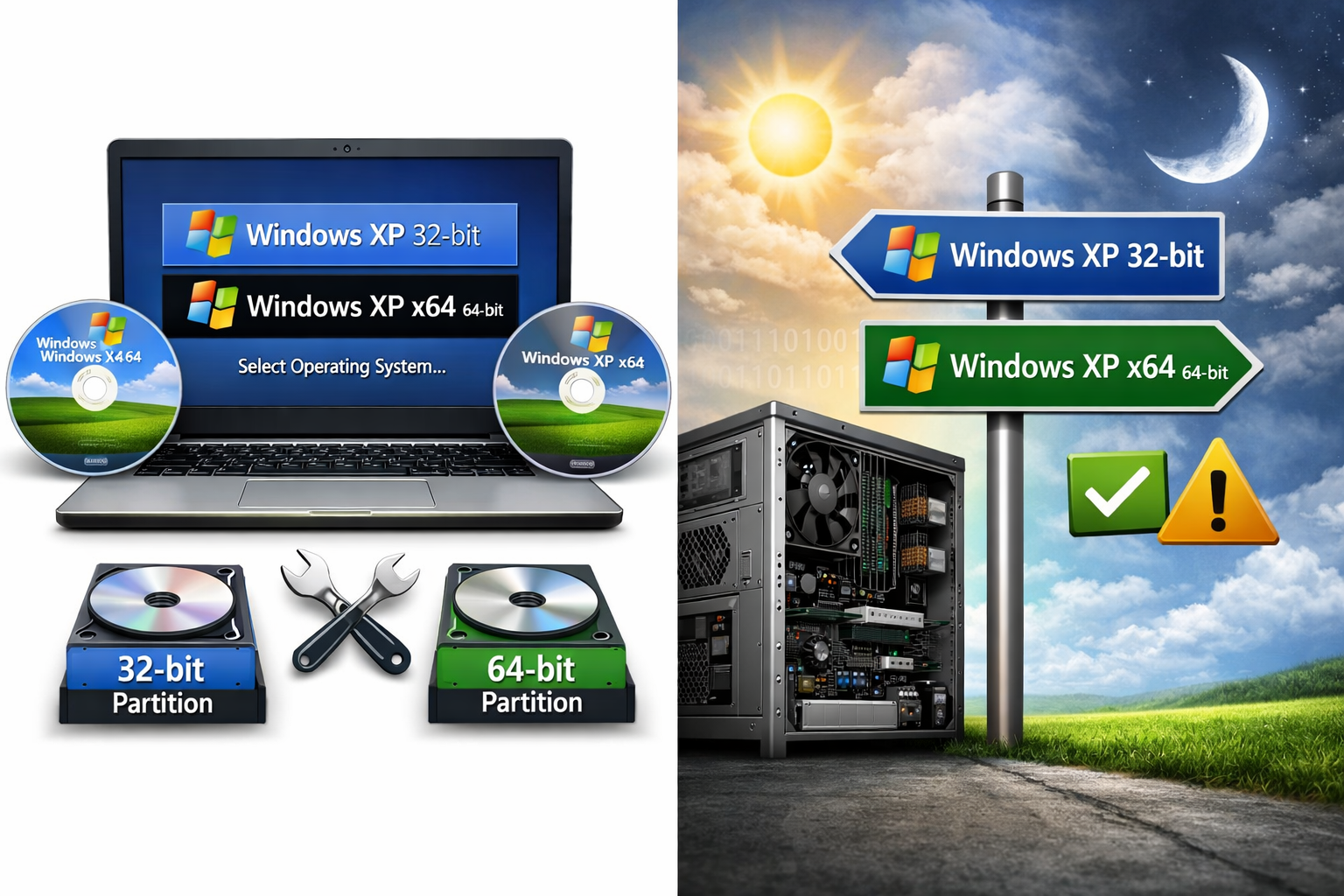
How to Dual Boot Windows XP and XP x64: Step-by-Step Guide
Dual booting allows you to run two different operating systems on a single PC, giving you the flexibility to switch between them as needed. This guide explains how to dual boot Windows XP and XP x64, a useful setup for developers, testers, or enthusiasts who need both versions for compatibility and performance testing.
Why Dual Boot Windows XP and XP x64?
Dual booting Windows XP (32-bit) and Windows XP x64 (64-bit) provides several benefits:
- Software Compatibility: Some older applications only run on 32-bit XP, while newer apps can take advantage of 64-bit XP.
- Testing and Development: Developers can test software on both architectures without needing separate machines.
- System Optimization: 64-bit XP can handle more memory efficiently, whereas 32-bit XP may be lighter on older hardware.
Prerequisites
Before attempting to dual boot XP and XP x64, ensure you have:
- Two separate partitions on your hard drive (at least 20 GB each recommended).
- Windows XP installation CD (32-bit version) and Windows XP x64 installation CD.
- Backup your important data to prevent accidental loss.
- A bootable USB or CD if your system does not have a CD drive.
Pro Tip: Using disk management tools like GParted or Windows XP setup can help create partitions efficiently.
Step 1: Prepare Hard Drive Partitions
- Boot into your current Windows XP system.
- Open Disk Management: Right-click My Computer → Manage → Disk Management.
- Create two primary partitions:
- Partition 1: Windows XP (32-bit)
- Partition 2: Windows XP x64 (64-bit)
- Format both partitions in NTFS, as it’s compatible with both versions.
Keyword optimization: “dual boot Windows XP partitions”
Step 2: Install Windows XP (32-bit)
- Insert your Windows XP CD and boot from it.
- Select the Partition 1 you created for 32-bit XP.
- Follow the standard installation prompts.
- Complete the installation and set up your username and password.
At this stage, your computer should boot into Windows XP 32-bit by default.
Step 3: Install Windows XP x64
- Insert the Windows XP x64 CD and restart your computer.
- Boot from the XP x64 CD.
- Select Partition 2 for installation.
- Follow the on-screen instructions to install XP x64.
Important: XP x64 installs its own bootloader, which will automatically detect your 32-bit XP installation and configure dual boot options.
Step 4: Configure Dual Boot Options
- After installing both systems, you’ll see a boot menu at startup with both versions of Windows XP listed.
- You can set the default operating system and the timeout (e.g., 10 seconds) in the boot menu configuration.
- To customize, open C:\boot.ini (read-only attribute must be removed):
[boot loader]
timeout=10
default=multi(0)disk(0)rdisk(0)partition(1)\WINDOWS
[operating systems]
multi(0)disk(0)rdisk(0)partition(1)\WINDOWS="Windows XP Professional" /fastdetect
multi(0)disk(0)rdisk(0)partition(2)\WINDOWS="Windows XP x64 Edition" /fastdetect
Pro Tip: Back up your boot.ini before editing.
Step 5: Verify Drivers and Updates
- XP x64 requires specific drivers for older hardware. Check the manufacturer’s website for 64-bit drivers.
- Update both systems with Service Packs and essential security updates for stable operation.
Troubleshooting Dual Boot Issues
- Missing Boot Menu: Use a tool like EasyBCD to restore or edit boot entries.
- Partition Not Detected: Ensure both partitions are primary, not logical.
- Driver Conflicts: XP x64 may not support some legacy 32-bit drivers—look for alternatives or compatibility modes.
Best Practices for Dual Booting XP and XP x64
- Keep system files separate to prevent corruption.
- Regularly backup important data from both partitions.
- Avoid installing third-party boot managers unless necessary.
- Document your boot configuration for future troubleshooting.
Conclusion
Dual booting Windows XP and XP x64 allows you to enjoy the best of both worlds: compatibility with older applications and the ability to use more modern 64-bit software. By carefully creating partitions, installing each version, and configuring the bootloader, you can switch seamlessly between the two operating systems.
With this setup, you can maximize your hardware efficiency and ensure access to legacy applications while experimenting with 64-bit computing.
Keywords: dual boot Windows XP, dual boot XP x64, install XP and XP x64, Windows XP dual boot guide, XP x64 setup, Windows XP bootloader, dual operating system XP, XP x64 installation, XP and XP x64 compatibility, Windows XP partitions.


