
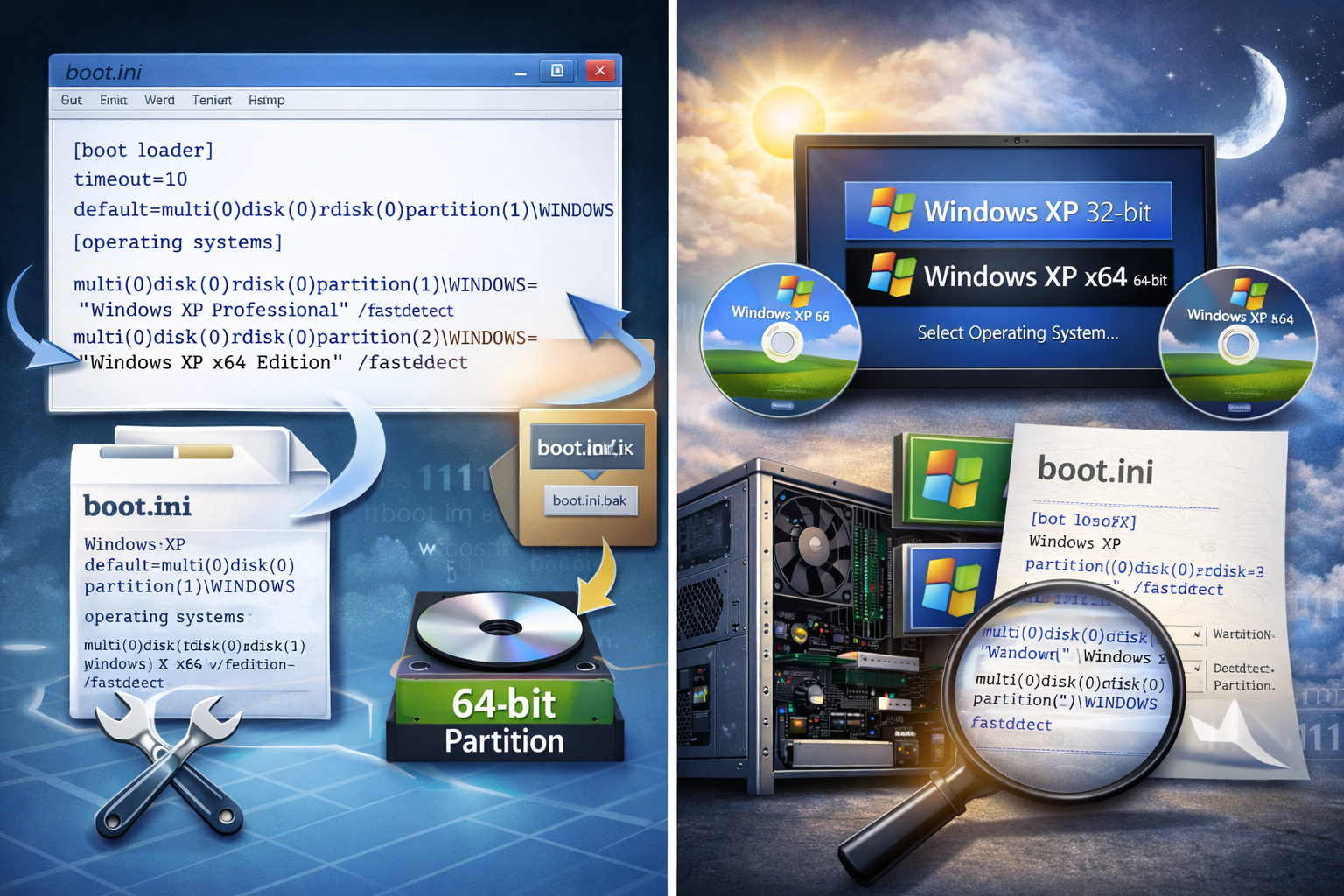
How to Dual Boot Windows XP and XP x64 Using Boot.ini: Complete Guide
Dual booting Windows XP and XP x64 allows you to run both 32-bit and 64-bit versions on the same computer, giving you flexibility for software testing, legacy app compatibility, and system optimization. The key to managing this setup is correctly configuring boot.ini, Windows XP’s classic bootloader file.
This guide provides a step-by-step process to dual boot Windows XP and XP x64 using boot.ini, ensuring a smooth and stable setup.
Why Use Boot.ini for Dual Booting XP and XP x64?
The boot.ini file is a system configuration file used by Windows XP to manage startup options. Proper configuration allows you to:
- Choose between 32-bit XP and 64-bit XP at startup.
- Set the default operating system and timeout for the boot menu.
- Prevent boot errors caused by misconfigured partitions or system files.
Keyword optimization: “dual boot Windows XP boot.ini”, “XP x64 boot configuration”, “Windows XP dual boot guide”.
Prerequisites Before Editing Boot.ini
Before you start editing boot.ini, ensure the following:
- Separate Partitions: Two primary partitions (minimum 20 GB each) – one for XP 32-bit, one for XP x64.
- Backups: Backup your boot.ini file and important data.
- Installed Systems: Both Windows XP and XP x64 should already be installed on their respective partitions.
- Admin Access: You need administrative privileges to edit system files.
Pro Tip: Set hidden and read-only attributes off to edit boot.ini safely.
Step 1: Locate the Boot.ini File
- Navigate to the root of your system drive (usually
C:\). - Make hidden and system files visible:
- Open My Computer → Tools → Folder Options → View → Show hidden files, folders, and drives.
- Uncheck Hide protected operating system files.
- You will see boot.ini at the root of C:.
Step 2: Backup Boot.ini
Before making changes:
- Right-click boot.ini → Copy.
- Paste it in a safe location like
C:\backup\boot.ini.
Keyword optimization: “backup boot.ini Windows XP”, “dual boot safety tips”.
Step 3: Edit Boot.ini for Dual Boot XP and XP x64
- Right-click boot.ini → Properties → Uncheck Read-only.
- Open boot.ini in Notepad.
- Your file should have sections like:
[boot loader]
timeout=30
default=multi(0)disk(0)rdisk(0)partition(1)\WINDOWS

[operating systems]
multi(0)disk(0)rdisk(0)partition(1)\WINDOWS="Windows XP Professional" /fastdetect
multi(0)disk(0)rdisk(0)partition(2)\WINDOWS="Windows XP x64 Edition" /fastdetect
- timeout: Number of seconds the boot menu appears before loading default OS.
- default: Partition of the default OS.
- partition(n): Partition number where each OS is installed.
- /fastdetect: Standard Windows XP boot parameter to speed up startup.
Pro Tip: Ensure partition numbers match the actual installation partitions to avoid boot errors.
Step 4: Save and Test Boot.ini
- Save the edited boot.ini file.
- Reboot your computer.
- You should see the boot menu with options for Windows XP and XP x64.
- Test booting into both systems to ensure proper configuration.
Step 5: Troubleshooting Boot.ini Issues
- Missing Boot Menu: Check that multi(0)disk(0)rdisk(0)partition(n)\WINDOWS paths are correct.
- Blue Screen or Boot Failure: Restore the backup copy of boot.ini.
- Timeout Too Short: Increase the
timeoutvalue to allow more time to select the OS. - Partition Not Recognized: Make sure the partitions are primary and formatted as NTFS.
Step 6: Optional Boot.ini Tweaks
- Change default OS easily:
default=multi(0)disk(0)rdisk(0)partition(2)\WINDOWS
- Hide an OS from the menu temporarily:
multi(0)disk(0)rdisk(0)partition(2)\WINDOWS="Windows XP x64 Edition" /fastdetect /hide
- Use a shorter timeout for faster boot:
timeout=10
Keyword optimization: “customize boot.ini Windows XP”, “dual boot XP timeout”, “boot menu customization XP”.
Best Practices for Dual Boot Using Boot.ini
- Always backup boot.ini before edits.
- Keep OS installations on separate partitions to prevent conflicts.
- Avoid third-party boot managers unless necessary.
- Document all boot.ini changes for future troubleshooting.
- Install drivers compatible with XP x64 for stability.
Conclusion
Dual booting Windows XP and XP x64 using boot.ini gives you full control over startup, enabling you to run 32-bit and 64-bit environments on a single machine. By carefully editing boot.ini, setting correct partitions, and following best practices, you can ensure a smooth, error-free dual boot experience.
This setup is ideal for developers, testers, and tech enthusiasts who need compatibility, flexibility, and efficiency in one system.
Tags: dual boot Windows XP boot.ini, XP x64 boot configuration, dual boot guide XP, Windows XP boot menu, edit boot.ini, configure boot.ini XP x64, Windows XP dual boot setup, XP 32-bit 64-bit boot, Windows XP partition boot, boot.ini troubleshooting.


